What a Reverse Mortgage Calculator Can’t Tell You About Your Net Cash Payout


You've entered your home value and age into an online reverse mortgage calculator and received an estimate - say, $300,000. While this figure is often close to the final amount, it may differ for borrowers with existing secured debts or super-priority obligations.
This article will explain why your final net cash payout might be lower than the initial estimate, detail the three types of payouts made before funding, and provide a worked example to show what your net payout could look like in practice.
What Determines Your Actual Reverse Mortgage Payout
The net payout formula is straightforward:
Your Real Net Cash Payout = Gross Approved Amount − Secured Debt − Mandatory Payouts − Closing Costs
Each item subtracted on the right side of the equation represents a deduction taken from your loan proceeds before the funds are disbursed to you. At closing, the lender settles these obligations directly on your behalf. This process ensures all prior claims against the property are cleared, which is a necessary step for the lender to secure their legal interest in the property, as we will explore next.
Why Your Reverse Mortgage Payout Is Lower Than the Calculator
Category 1: Existing Secured Debts
In Canada, every reverse mortgage lender — whether HomeEquity Bank (CHIP), Equitable Bank, Bloom Financial, or Home Trust — requires their mortgage to hold first lien position on your property's title. This is a standard regulatory requirement known as the first charge rule.
In practical terms, any debt currently registered against your title must be fully discharged at closing using your reverse mortgage proceeds. This commonly takes three forms.
Existing Mortgages
If you still carry a balance on a traditional mortgage, the full outstanding amount is paid directly to that lender at closing. This is typically the largest single deduction. For many homeowners, paying off an existing mortgage is in fact the primary goal of the transaction — and it is helpful to account for it when estimating your net cash.
Existing HELOCs
A Home Equity Line of Credit is registered on your title at its full credit limit, not its current drawn balance. If your HELOC is approved for $150,000 but you have drawn only $30,000, the lender still requires the entire facility to be closed and discharged. The full registered amount must be cleared, because the lender cannot hold first position while an open revolving credit facility remains on title.
Prepayment Penalties
Discharging an existing mortgage before its maturity date may trigger a penalty charged by your current lender. In Canada, the most common penalties are either three months' interest or the interest rate differential (IRD), whichever is greater. This amount is calculated by your existing lender and deducted directly from the payout. On a large balance held at a low locked-in rate, this figure can be meaningful, so it is worth confirming in advance.
Category 2: Existing Super-Priority Debts
This second category covers obligations that are not traditional mortgages but that a reverse mortgage lender still requires to be cleared at closing. These are debts that, if left outstanding, could legally rank ahead of the lender's security interest.
Property Tax Arrears
Municipal property taxes carry super-priority status under Canadian law, meaning unpaid property taxes can legally rank above a registered mortgage holder's claim. Because of this, lenders require any property tax arrears to be resolved before funding. If you are behind on municipal taxes, the lender pays the municipality directly from your proceeds before releasing the remaining funds to you.
CRA Liens
The Canada Revenue Agency has broad authority to register liens against real property for unpaid income tax debt. As reflected in federal court jurisprudence, the CRA may pursue amounts even from secured creditors in certain circumstances involving GST/HST arrears (Toronto-Dominion Bank v. Canada, 2020). A CRA lien registered against your title is therefore a mandatory payout at closing. The lender will verify your title through a lawyer before funding, and any outstanding CRA judgment must be cleared.
Active Consumer Proposals
Some reverse mortgage lenders require evidence that an active consumer proposal has been fully discharged before they will fund. The rationale is practical: a proposal reflects existing insolvency considerations, and lenders prefer borrowers to demonstrate sound financial standing before advancing a large, interest-compounding loan. Where a proposal is active, its full discharge may need to be funded from your proceeds, depending on your lender's specific policy.
Category 3: Reverse Mortgage Closing Costs
These are the standard transactional costs of setting up a properly structured, legally protected loan. Most are deducted directly from your proceeds, so you generally do not need to bring cash to closing. For a complete breakdown of all applicable fees, see our Deep Dive into Reverse Mortgage Closing Costs.
Independent Legal Advice (ILA) Fees
Every reverse mortgage in Canada requires the borrower to obtain Independent Legal Advice from a lawyer of their choosing. This is a regulatory requirement and an important protection. The ILA lawyer works exclusively for you — not for the lender — and confirms that you understand the loan's terms, including the events that can trigger repayment (known as Due Date triggers), your right to prepay, and your obligations as the homeowner. ILA fees typically range from $500 to over $1,000, depending on the lawyer and province.
Administration Fees
Lenders charge an administrative fee to cover processing, underwriting, and registering the mortgage. The exact amount varies by lender. In most cases, this fee is deducted from your proceeds at closing rather than paid out of pocket.
Home Appraisal Cost
An independent property appraisal is required for all Canadian reverse mortgages. The appraiser confirms the current market value of your home, which forms the basis of the entire loan calculation. Some lenders allow the appraisal cost to be deducted from proceeds; others require it to be paid upfront. Either way, it is a real cost that reduces the net amount available to you.
Reverse Mortgage Payout Example: A $300,000 Approval
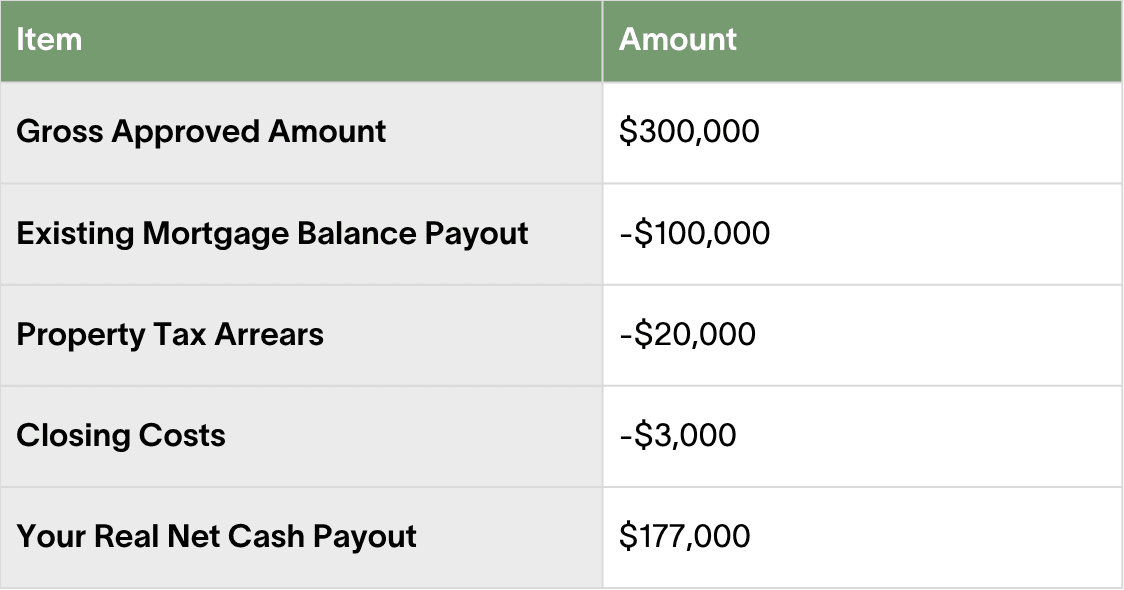
Here is how the deductions may apply in a realistic scenario:
Table 1. Reverse Mortgage Net Cash Payout Calculation
| Item | Amount |
|---|---|
| Gross Approved Amount | $300,000 |
| Existing Mortgage Balance Payout | -$100,000 |
| Property Tax Arrears | -$20,000 |
| Closing Costs | -$3,000 |
| Your Real Net Cash Payout | $177,000 |
It’s entirely possible for there to be a $123,000 difference between an initial online estimate and your final payout if you have $120,000 in existing secured debt. This discrepancy happens because standard online calculators don't account for your existing debt obligations. The final figure isn't a reduction of your approved amount, but rather a complete picture of your net payout after all deductions.
How to Get an Accurate Net Cash Estimate
A reverse mortgage calculator is a reasonable starting point. It indicates whether you are in the right range for eligibility. The precise number, however, requires a licensed professional who can review your existing debts and property profile.
At Canadian Reverse Mortgage Advisors, the first step in every client engagement is a strategic mortgage assessment. Before discussing rates or lenders, we map out your full payout picture so you understand exactly what your net advance looks like — well before you commit to anything.
Looking to Get a Custom Net Cash Estimate? Call us at (416) 821-8601 or book a meeting to get clear, personalized guidance on your options.
Reverse Mortgage Payout FAQs
About the Author
Alexander Gasenko
Mortgage Broker, Reverse Mortgage Specialist
Alexander is the founder of Canadian Reverse Mortgage Advisors team and a licensed mortgage professional serving Ontario, British Columbia, and Alberta. With a degree in Economics and a background in banking, he’s passionate about helping Canadian seniors protect their equity and navigate rising living costs. When he’s not negotiating with lenders, Alexander shares financial insights on his YouTube channel, empowering Canadian homeowners to make informed decisions. His mission? To provide clarity and confidence for a secure financial future.